

- November 26, 2026
- Selina Wilson
- 0
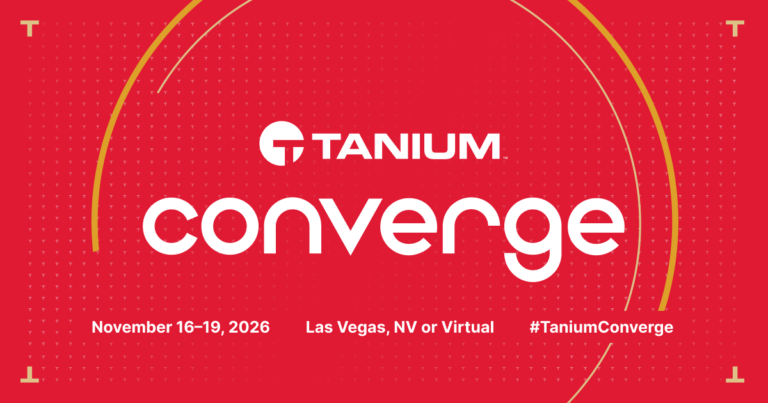
Tanium Converge 2026 took place in Las Vegas, Nevada this year and made one thing clear: autonomous IT has moved off the roadmap and into production. Some of the world’s largest organisations are already running it, and they have the numbers to prove it.
Converge 2026, Tanium’s 11th, ran from 16 to 19 November at ARIA in Las Vegas, with more than 2,000 attendees, 100+ speakers, 120 sessions and 90+ hands-on labs.
As EMEA’s largest Tanium partner, PointWire sent seven members of staff to Converge this year, including our CEO. Between us we covered the keynotes, the partner programme and as many of the customer and partner breakout sessions as we could fit in. This post pulls together what we think matters most for organisations in the UK and across EMEA.
What Tanium announced
The headline launch was Tanium AgentSight, which extends Tanium’s real-time endpoint visibility to the AI agents, local models and MCP servers now running on corporate devices. It arrived alongside a clear shift in positioning: Tanium now calls itself “the agentic defense company”, with Tanium Atlas, its AI agent, at the centre of the platform.
Converge 2026, Tanium’s 11th, ran from 16 to 19 November at ARIA in Las Vegas, with more than 2,000 attendees, 100+ speakers, 120 sessions and 90+ hands-on labs.
The message behind AgentSight is that AI now needs governing as well as using. Tanium is betting that the same endpoint data that powers patching and hunting is the right place to see and control the agents employees are installing.
1. Autonomous patching is delivering hard numbers
The strongest sessions led with outcomes, not features. Customers are now reporting patching results that would have sounded implausible a few years ago:
- MUFG reported 92% fewer aged vulnerabilities by pairing Tanium with ServiceNow, closing the loop between finding a vulnerability, raising the change and remediating it.
- Hyundai AutoEver America described 97% compliance with zero failures using Atlas-enabled autonomous patching and continuous remediation.
- JLL showed how it moved device quarantine for critical risks from a manual task to an automated, scalable response.
The lesson for EMEA teams is that the hard part is no longer the tooling, It’s agreeing the guardrails that let you trust automation enough to let it run. Organisations that define those policies up front are the ones getting to the 90%+ numbers.
2. AI and Atlas have moved from pilot to production
Last year the AI conversation was about potential – this year it was about hours saved and workflows handed over.
- SAP reported 500 hours saved in two months by combining Atlas, AI and automation.
- ServiceNow showed how its own IT organisation runs as a “self-healing enterprise” on Tanium, and ServiceNow took Tanium’s Technology Alliance Partner award.
- ScreenMeet and Tanium walked through an agentic help desk, moving from human-assisted support to autonomous resolution with Atlas.
- SimCorp, a Copenhagen-headquartered firm, described building its own MCP server for Tanium and then helping shape Tanium’s official one, a good example of customers driving the developer ecosystem Tanium is now expanding.
- AWS covered how Amazon Bedrock and Atlas fit together for organisations standardising on AWS for AI.
The most useful corrective came from Epiroc, whose session title says it all: the AI security team member that hallucinates but still gets invited to meetings. AI is valuable, but it needs human review, clear scope and verifiable data underneath it. That is also why AgentSight matters – as organisations deploy their own agents, they need the same visibility and control over those agents that they expect for any other software on the estate.
3. Consolidation and integration are where the value compounds
Tanium increasingly sits at the centre of the IT and security stack rather than beside it, and several sessions focused on making that transition safely.
- McDonald’s shared how it led a global move from SCCM to Tanium without disrupting operations. With many EMEA organisations reviewing their Configuration Manager estates, this was one of the most relevant sessions for our customers.
- Avanade showed how it automated Tanium with Azure Arc to govern a global philanthropic non-profit at machine speed, a pattern that suits Microsoft-centric hybrid estates.
- AHEAD covered extending Tanium with custom content for automation, administration and complete solutions.
- Indianapolis Airport Authority discussed IT and OT convergence behind the terminal walls, and CBRE covered combining automation with intelligence at scale.
The lesson is simple: consolidate in phases, not in one big switch. Measure each step and integrate it with ITSM (usually ServiceNow) and your cloud management tools, so every stage takes a tool or a manual task away rather than adding one.
4. Security operations and exposure management run at the speed of the endpoint
Attackers using AI and legitimate admin tools move faster. The security sessions focused on closing that gap with real-time endpoint data.
- U.S. Bank explained how it built a telemetry foundation that takes it from logs to live hunts, as a prerequisite for more autonomous SecOps.
- Capgemini, Tanium’s EMEA Growth Partner of the Year, argued that “speed is the new perimeter”.
- Censys presented 2026 attack surface trends, with exposure now changing faster than most teams can track.
- Air France-KLM described rewiring compliance to operate in real time with the goal of zero blind spots.
- ServiceNow and the DVMS Institute proposed moving from GRC to “GRAA”, governing by assurance in the age of ransomware.
For regulated organisations in the UK and EU, the Air France-KLM and GRAA sessions are a useful frame for evidencing continuous control effectiveness under DORA and NIS2, rather than relying on point-in-time audits.
5. Adoption, governance and data quality decide whether it sticks
Autonomy depends on trust, and trust depends on people and data as much as technology. Three sessions made this point directly.
- Corebridge Financial used Tanium role-based access control (RBAC) to let multiple teams share one platform, and used that shared ownership to fund a company-wide security investment.
- University of Utah covered change management across autonomous IT groups, earning adoption rather than mandating it.
- Chuco focused on keeping a Tanium deployment reporting accurately at scale. If the data is incomplete, every automation and every AI answer built on it inherits the gap.
This is the least glamorous takeaway and probably the most important. Before handing decisions to Atlas or automated patching, make sure client health, coverage and content hygiene are in order, and that every team with a stake in the platform has a clear, scoped role in it.
What this means for EMEA organisations
Our seven-strong team came home with a simple message for customers: the organisations getting the most from Tanium did the groundwork first, then automated with confidence. For most EMEA organisations, we would prioritise:
- Baseline your platform health. Check coverage, client health and reporting accuracy before scaling automation or AI.
- Pick one measurable automation win. Autonomous patching for a defined device group, with clear rings and rollback, is the fastest route to a number your board will notice.
- Get visibility of AI on your endpoints. Shadow AI is already on your estate. AgentSight’s discovery and Shadow AI view are available now, with governance controls to follow.
- Plan your SCCM and tool consolidation. Phase it, integrate it with ServiceNow or your ITSM, and retire tools as you go.
- Map controls to regulation. Use real-time endpoint evidence to support NIS2, DORA and Cyber Essentials obligations.
As EMEA’s largest Tanium partner, PointWire helps organisations design, deploy, optimise and run Tanium, from health checks and SCCM migrations to Atlas, autonomous patching and Security Operations. If you would like to discuss any of the sessions above or what they mean for your estate, get in touch with the team.