


- October 14, 2026
- Andrew Samson
- 0
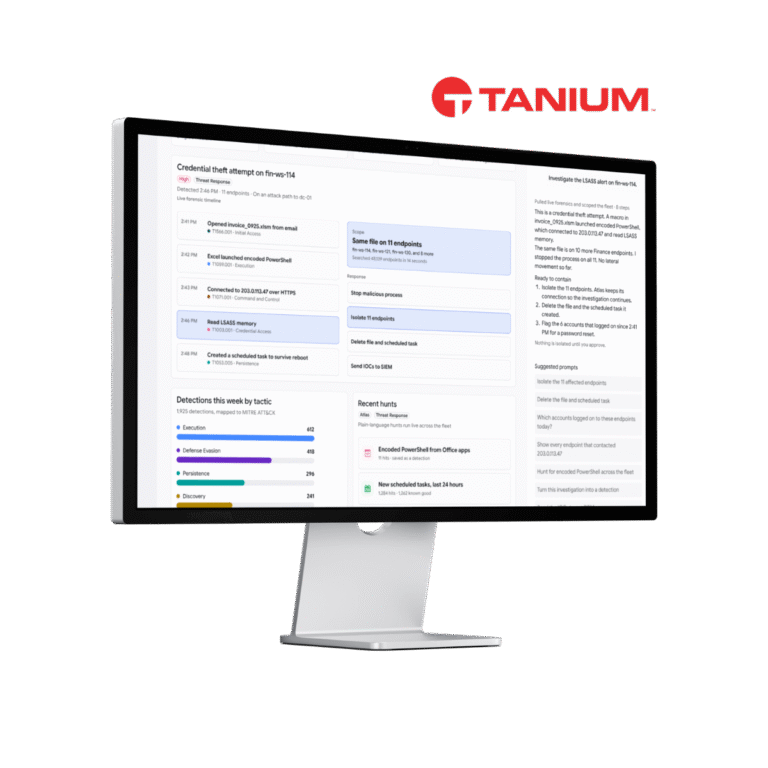
The most difficult attacks rarely look like attacks. They begin with a valid login, use tools your IT team already relies on, and move at a pace that is hard for a person to follow.
That is the problem Tanium says its relaunched Security Operations platform is built to address.
What Tanium announced
On 6 October, Tanium relaunched Tanium Security Operations, describing it as an update for attackers who sign in with stolen credentials and use the same administrative tools IT teams rely on every day. The security capability builds on the same platform and real time endpoint data that many organisations already use to manage their devices.
What is new is how the capability is brought together. Tanium says detection, response and threat hunting now run as one continuous workflow, rather than as separate steps passed between tools. The platform is designed to work alongside existing SIEM and EDR tools, not replace them.
Tanium has added Endpoint Drift, which learns how each device normally behaves and ranks those acting out of character. It has also replaced its previous process injection detection with an Insights Engine designed to spot attackers hiding inside trusted processes.
Response actions can run directly on endpoints, from stopping a process and collecting evidence to isolating a host, either on one device or across a wider estate. Tanium has also introduced a Federated SOC model, allowing separate teams to use the same platform while retaining their own suppression rules and response settings.
What this means in plain English
Imagine an attacker gets hold of a valid user account. They do not need to install anything unusual. They can sign in, run a standard administrative tool and look, at least at first, like someone doing their job.
Traditional controls are good at spotting known bad files. They are less effective when the “bad” activity is a trusted tool being used in an unexpected way. That is the gap Tanium is aiming at.
The practical shift is from asking “what file did this come from?” to asking “is this normal for this device, this user and this moment?” Endpoint Drift is designed to help answer that question by comparing current behaviour with what is normal for each endpoint.
The second shift is speed. If a device is behaving unusually, security teams need to investigate it, collect evidence and, if necessary, contain it without waiting for several tools to pass the problem between them. Tanium’s relaunched approach is intended to reduce that handoff.
Where most organisations start
Most organisations begin with Tanium for the basics: operating system and third-party application patching, visibility and reporting. Security operations tend to come later, as a maturity step once those foundations are under control.
That is a sensible order. The same endpoint data that supports patching and reporting is what makes behaviour-based detection possible, so the groundwork is not wasted. The question is not whether to add security operations immediately. It is whether your current use of Tanium is ready to support it.
What PointWire adds
If you already use Tanium for visibility and patching, the next step is configuring and integrating security operations, so it fits how your teams work. That is where PointWire helps.
That includes:
- Understanding where Tanium fits alongside your existing SIEM, EDR and identity controls.
- Turning detection and response capability into workflows your security and IT teams can actually use.
- Helping teams define what “normal” looks like across their endpoints, so alerts are relevant rather than noisy.
- Supporting investigation and response so that findings lead to clear actions and evidence.
- Providing guidance on deployment, integration and operational ownership, so the capability does not sit unused after go live.
Why this matters now
Attackers using valid credentials and trusted tools are harder to spot because they exploit trust, not just a technical flaw. A platform that can see endpoint behaviour, support rapid response and make hunting more accessible gives security teams a better chance of acting before impact spreads.
The value is not in having another tool. It is in shortening the distance between seeing something unusual, understanding it and doing something about it.
Questions to ask your team
- Can we see what normal activity looks like on our endpoints, not just across the estate?
- If a trusted admin tool is used unusually, who investigates it and how quickly?
- Can security and IT work from the same endpoint data during an incident?
- Do our response actions work at the scale of the environment, not just on one device?
Next step
If you are already using Tanium for patching, visibility and reporting, ask whether your security operations configuration and integrations are keeping pace. If you would like help assessing where Tanium Security Operations fits in your environment, talk to us today.